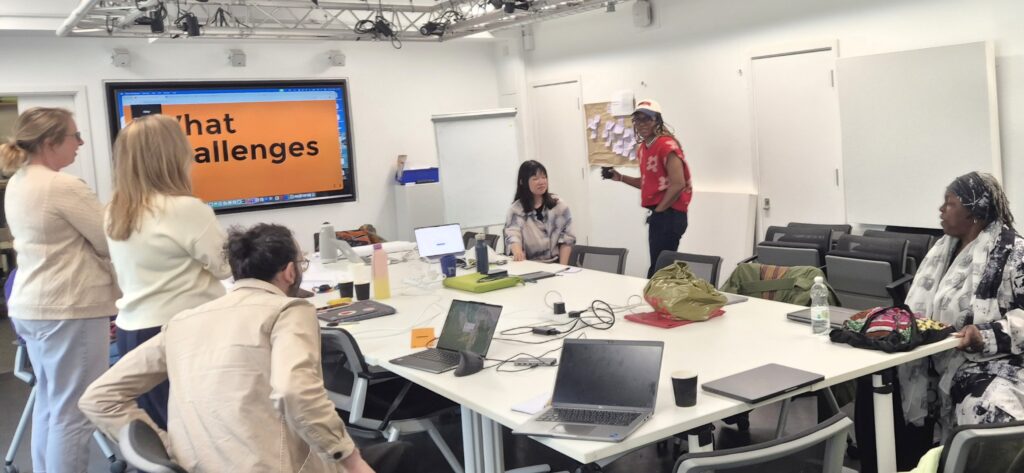
We’re halfway through Sustainable AI Futures! This is a moment to reflect on where we’re at. Famously, there are some diverse views within the core project team, and yet we seem to muddle along anyway. What are we, a centrist podcast?
So this post doesn’t represent the full breadth of views within the project. Check out individual articles and other publications under RESOURCES for the fuller picture. But there are some questions and approaches taking shape across our work that we’d like to share.
Our starting question was how to govern AI’s environmental impacts responsibly. AI is promoted as a means of tackling climate change, while its expansion places growing demands on energy, water, land, and minerals. How should we understand that relationship? Is it just a matter of totting up costs and benefits, and hopefully coming out with a positive number?
As you may have already guessed, it is not.
AI enters a world already densely populated by climate models, carbon accounting dashboards, environmental management plans, sustainability reporting standards, market rules, corporate net zero targets, and other frameworks, metrics, and tools.
We’re interested in the “social life” of these things. How are they made and used? What kinds of action do they support? What happens when they leave their designers’ hands?
Increasingly we’re thinking not only of reporting standards and software tooling, but a broader repertoire that includes law, policy, campaigning and activist tactics, and other levers and drivers of change. In other words, we’re interested in “the repertoire of contention” available to those who care about AI and the environment.
Things have been changing around us.
When we proposed the project, environmental critiques of AI still felt fairly niche.
During the past two years, the climate impact of AI has become very prominent in public debate and organising. Environmental organisations and wider grassroots movements have been challenging the big data-centre build-out, as well as the kind of futures it implies. Water is often as big, or a bigger issue, than energy.
Meanwhile, methods for assessing environmental impacts have developed, alongside practical tools and reporting requirements. When we began, you could more-or-less say “Nobody knows how to measure AI.” Now it’s a bit closer to, “Nobody agrees how to measure AI.” And there is at least a degree of consensus on what should be considered. The work of ITU is a good starting point here, if you’re looking for one, as is that of the Green Software Foundation.
Sus AI Futures have been finding our place within this much busier conversation …
HARMONISING STANDARDS ON A WARMING PLANET (part 1)
Although, all that said, some aspects of the conversation haven’t changed that much in the past couple years.
This is a familiar refrain: “We need greater transparency (from data centre operators and other actors), we need to measure AI’s impacts more accurately, and we need to harmonise the diverse methodologies and standards so that different assessments become comparable.”
Transparency, measurement, harmonization. We continue to see value in these activities, and are even contributing to some of them. But we do question how much priority they should enjoy.
Transparency alone–even granular, accurate data, even with standard harmonization–won’t be enough. What happens after a company discloses its energy use? Does this affect planning permission, access to electricity, eligibility for public funding, or anything else? Does anyone have the power and resources to act on the information? Disclosure can support intervention, but it can also become a routine that organisations comply with while continuing much as before.
Transparency is always at best a stepping stone, allowing an agent to become legible to power which might constrain and shape its actions … consumer power, investor power, regulatory power.
The timescales are crucial. You can be pretty specific about this. A proposed standard has a development schedule, which it may or may not stick to. A directive or law has consultation periods, implementation deadlines, enforcement arrangements. Companies have their investment and procurement cycles, and lock-in may make it difficult to shift to more sustainable tech solutions.
Examining how long previous policy took helps us to estimate when a measure might influence decisions about building infrastructure or deploying AI, and where delays are likely. Those estimates will have uncertainties, of course! But they offer something more useful than a general reassurance that governance is coming.
Climate timescales give this question some urgency. 1.5°C is now effectively missed. The IPCC’s AR6 pathways for limiting warming to 1.5°C with little or no overshoot required global greenhouse-gas emissions to fall 43% below 2019 levels by 2030 and 60% by 2035, with net-zero CO₂ reached in the early 2050s. Emissions have instead remained close to record highs, consuming most of the remaining carbon budget.
Individual years above 1.5°C are not the same thing as permanently breaching the Paris temperature threshold, which is defined over longer periods. But the pathways that would have held warming to 1.5°C without significant overshoot have ceased to be credible. That is a tragic loss, and it makes the difference between 1.6°C, 1.7°C, 1.8°C and 2°C all the more important.
For our project, 1.7°C provides a useful benchmark. It is not an official Paris Agreement target, but it gives a concrete interpretation of the commitment to hold warming “well below 2°C”. The 2025 Global Carbon Budget estimates that, from the start of 2026, roughly 525 GtCO₂ remained for a 50% chance of limiting warming to 1.7°C.
At current emissions of around 42 GtCO₂ per year, that budget would be exhausted in little more than a decade. This isn’t the kind of thing you can hurriedly fix the night before. A roughly linear fall from current emissions to zero around 2050 would itself use about 500–525 GtCO₂. So the emissions curve has to bend sharply before 2030, with global net-zero CO₂ reached around mid-century. This needs to be distributed differently for different countries (and perhaps at other scales as well), with those that have the most pressing development needs decarbonising later.
For 1.8°C there is somewhat more room, pushing plausible net-zero dates further into the 2050s, but not by very much.
These timelines should be what every conversation about AI measurement begin with.
If the suite of policy that is going to make AI’s climatic impacts visible and tractable is going to kick in in 2030, or 2034, or 2038, we need to be doing something else in the meanwhile.
HARMONISING STANDARDS ON A WARMING PLANET (part 2)
There does seem to have been some progress in the past couple years. But given remaining carbon budget for 1.7 degrees, it’s not nearly enough. And the precedents are sobering.
Consider, for example, the EU’s AI Act. The White Paper appeared in 2020. Most AI Act provisions apply from August 2026, but the revised timetable extends to December 2027 and August 2028 for different categories of high-risk systems: almost eight years from the White Paper. These are not themselves environmental controls. For environmental sustainability, August 2028 is a deadline for reviewing the effectiveness of voluntary codes and considering whether further measures are needed. Additional requirements could take longer to acquire practical force.
Corporate sustainability reporting offers a partial precedent as well. The Task Force on Climate-related Financial Disclosures began in 2015 and issued recommendations in 2017. Its work fed into the International Sustainability Standards Board, established in 2021, which published its first standards in 2023. Adoption across jurisdictions is still unfolding in 2026. That is more than a decade of institution-building, with earlier reporting initiatives also contributing along the way.
The Greenhouse Gas Protocol stretches back further, and makes for an interesting and complicated comparison. Work began in the late 1990s, its first corporate standard appeared in 2001, and its Scope 3 standard followed in 2011. Scope 3 covers emissions elsewhere in a company’s value chain, including those associated with purchased goods and the use of products it sells. The Protocol has shaped corporate accounting throughout this period, yet coverage remains incomplete. CDP’s 2025 Corporate Health Check found that 45% of disclosures were missing companies’ most significant Scope 3 categories. A consolidated standard developed with ISO is now scheduled for late 2028, roughly thirty years after the initiative began. Publication will itself leave further work of adoption and implementation.
These histories show why we need to distinguish early influence, formal adoption, enforcement and eventual environmental effects. We can then compare plausible dates for those effects with the emissions reductions required over the same period. The IPCC’s pathways for limiting warming to 1.5°C or 2°C involve rapid and deep reductions within this decade. A policy expected to become effective in the 2030s needs to be assessed against that timetable, including what happens while we wait.
There is growing interest in approaches that prevent measurement complexities from becoming a bottleneck. One is to govern through conditions on access to infrastructure. Ireland’s electricity regulator, for example, requires new data-centre connections to provide matching generation or storage capacity and meet at least 80% of annual electricity demand through additional renewable projects in Ireland.
Another is a moratorium on new data-centre approvals and construction, called for by more than 230 US organisations in December 2025. A pause can prevent further commitments while safeguards are developed, without requiring agreement on the footprint of every model or the value of every application. This is just a campaign demand, of course.
Both approaches deserve more research, including into enforcement, exceptions, the possibility of shifting development elsewhere, and whose needs take priority when electricity or water is scarce. And we need fresh ideas.
IS AI SO BAD FOR THE CLIMATE? AI AND DEFERRED MITIGATION
How important is measurement anyway? Our understanding of the effects that need governing has also broadened. Enabled emissions have become a clearer priority. These are emissions arising from activities AI helps people undertake, such as finding and extracting more oil and gas. They extend the discussion beyond the direct and indirect impacts of data centres, networks and devices. An AI system could become more efficient to operate while helping another industry increase its emissions. There are loads of plausible ways of modelling these, fit for this purpose or that.
We are also paying closer attention to deferred mitigation: emissions reductions postponed because a technological solution is expected to arrive later. This connects with our interest in techno-solutionism, the tendency to present technological innovation as an answer to problems whose resolution also requires political and economic change. Promises about AI can influence decisions today, well before the promised capabilities or benefits exist. If you’re interested in finding out more, the work of Holly and Will Alpine is the significant place to start.
AI needs to be understood within the history of climate technologies whose benefits have failed to materialise at the anticipated scale. In 2009, the International Energy Agency envisaged carbon-capture projects storing around 300 million tonnes of CO₂ annually by 2020. By 2020, capture capacity was only about 40 million tonnes annually. Obstacles included financing, infrastructure, commercial incentives and inconsistent policy support. This history gives us reasons to examine the conditions attached to AI’s projected benefits, and to include scenarios where deployment stalls or savings never arrive.
We’re not equating AI with these earlier technologies, or saying to that history would need to repeat itself. But everything that had a bearing on these empty promises needs to be inspected, to see if it might still be an active distraction from the important work at hand.
NET IMPACTS, AND DISTINGUISHING AI SYSTEMS
This has brought our work into closer conversation with critiques of greenwashing. AI may help reduce emissions in particular settings, but moving from a promising application to a prediction of large global savings involves many assumptions.
Ketan Joshi has a metaphor: The runners are at the starting line, and the starting pistol fires. They have to get to net zero as quickly as possible. Only … they all start running in the opposite direction.
It’s not as crazy as it sounds. They’ve heard there might be useful things back there — bicycles, pogo sticks, jetpacks, maybe a teleporter — which means that backwards actually is the quickest way forward. But as these technological marvels again and again fail to appear, or appear but disappoint, can the world’s most vulnerable populations really tolerate any more of this particular kind of optimism?
Ketan Joshi’s report The AI Climate Hoax: Behind the Curtain of How Big Tech Greenwashes Impacts offers a very useful parallel to some of our findings on the evidence base for “AI for sustainability”. It examines both the supporting evidence and the logic through which benefits from particular applications become claims about AI generally. Especially relevant is its account of how examples involving relatively established, specialised machine learning are used to defend an expansion increasingly associated with consumer generative AI. Evidence that one application is useful does not establish the climate benefits of another.
These distinctions complicate attempts to calculate a single “net climate impact of AI”. Such calculations typically compare emissions associated with AI against emissions its applications might save. Which effects belong on each side? Are enabled emissions included? What about action deferred by promises of future benefits? How should we compare immediate emissions with uncertain savings years later?
Some of these questions involve what researchers call “deep uncertainty”. People may disagree about which effects belong in the model, how the relevant systems behave, or what would happen without AI. Producing a more precise-looking number does not resolve those disagreements.
CAN WE HAVE THE “GOOD” AI WITHOUT THE “BAD”?
It’s certainly an idea that is cropping up a lot, particularly when you acknowledge the great variety of things that are lumped together under the title “AI.” Many of the most successful climate-related AI applications are not LLMs at all, but much more lightweight, domain-specific creatures.
Aggregating everything into one global balance can perhaps obscure choices. Presumably, policymakers could support some applications and constrain others. But this creates a substantial research question of its own: can policy reliably distinguish between AI systems and uses on environmental grounds, and how?
Familiar categories only take us so far. Generative or predictive, large or small, general-purpose or specialised: none maps neatly onto environmental consequences. A small model embedded in consumer software, and queried billions of times, might consume more energy over its lifetime than a larger model used sparingly.
Purpose and deployment scale are crucial. So are interfaces, UI and UX, and default settings, which can make a resource-intensive system the automatic option for everyday tasks.
Can we practically distinguish different AI systems by probable environmental impacts, to make some more costly (or prohibited entirely), whilst supporting others? Would such attempts be gameable?
There are very partial, very incipient, policy precedents, e.g. the EU AI Act distinguishes between particular uses, prohibiting some practices and placing additional obligations on specified high-risk applications. Its classifications concern safety and fundamental rights, rather than providing an environmental ranking, but they demonstrate how obligations can attach to the purpose and context of use.
There are other interesting experiments we’re trying to keep an eye on. Singapore’s second competitive allocation process for new data-centre capacity assesses proposals according to strategic value, economic contribution and sustainability commitments. This makes access to infrastructure conditional on judgements about what a development contributes. It does not distinguish individual AI workloads by their environmental effects, but it offers a precedent for selective allocation, rather than treating all demand as equally deserving of accommodation.
It remains incredibly thorny, understudied and underimagined. An environmental approach would need categories that decision-makers can understand and enforce, while accounting for changing uses and systems that serve many purposes. It would also need to connect classification to consequences, such as procurement eligibility, funding conditions or restrictions on particular applications. Otherwise, we risk producing another label with little influence over what happens.
Dan McQuillan’s work is skeptical of any kind of “good AI vs. bad AI” framing. In fact, AI becomes a window onto something bigger and deeper. Dan writes:
“Resisting AI is vital, but the systems which need reimagining and reclaiming go far beyond a specific form of computation. Rather than treating the AI industrial complex as the protagonist in this historical moment, we should instead take AI as diagnostic of deeper contradictions.”
Here, the test for an alternative includes the social relations it helps create. Convivial technology means technology people can meaningfully control and adapt together. Dan continues:
“AI is both a specific technology and a morbid symptom of our technocratic and capitalist condition, with shared foundations in limitless expansion, extraction and concentration of power. A diagnosis of AI’s contradictions and overreach is also a guide to a viable path beyond AI, one that reclaims convivial technology and re-centres a feminist ethics of care.”
A feminist ethics of care directs attention to interdependence and the often undervalued work of sustaining life. This sets a different ambition from making the existing AI industry less environmentally damaging. If this feels more appealing, what’s next?
AGAINST ALTERNATIVE IMAGINARIES?
All this also gives us reasons to scrutinise attractive alternatives. Smaller systems, local control, reused hardware and community ownership may offer substantial benefits. But does a small, locally accountable project help displace damaging infrastructure, or grow alongside it?
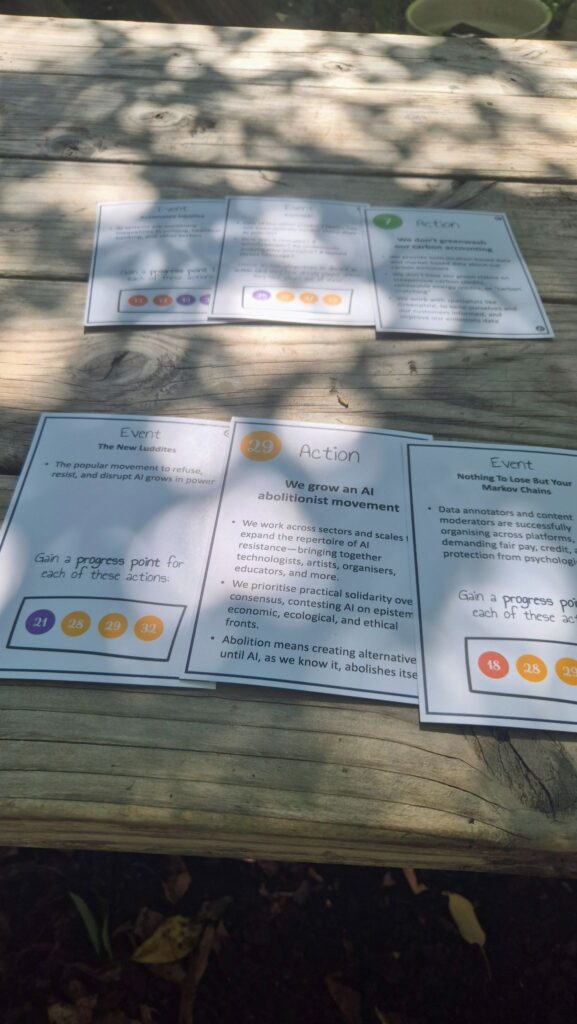
As we enter the second half of the project, we’re also becoming more interested in tactics: ways of intervening that may involve a standard, a policy proposal, a piece of software tooling, or a campaign, a community experiment, a story, direct action, a mutual aid network, or something else entirely.
So this brings us to something even thornier: what you could call our models of what is modellable. Modelling does not begin only once we have selected variables and built equations. Before that comes a prior judgement about what kinds of things can legitimately be rendered as variables at all. Why? Cultural instincts, institutional habits and technical capacities bring some phenomena into view as measurable, comparable and tractable, while leaving others hazier or outside the frame.
So for instance, energy demand, compute efficiency and investment cycles readily invite modelling. Whereas … call it hope, solidarity, political imagination, or a shift in collective consciousness … these things may seem to resist it. There is something almost grotesque about asking for the expected annual rate of increase in hope, or whatever it may be.
But this creates a problem for approaches to AI and climate that place their faith precisely in those less tractable forms of change. They can seem to be suspended outside of time.
Green growth, the status quo, at best imagines existing institutions being redirected through innovation, standards, incentives and investment. As Fieke Jansen and Iliana Depounti argue in a paper in progress, the dominant discourse of “AI for sustainability” reframes the climate crisis as a problem to be managed through technological innovation rather than structural economic change. Their analysis focuses on major management consultancies, which increasingly present AI as a tool for climate mitigation and adaptation while also helping define the terms of corporate climate governance. Drawing on Marxist accounts of circulation, Fieke and Iliana argue that what is being sustained is not simply the planet, but the movement of capital itself. AI is getting sold as a means of managing climate risk, preserving investment, and keeping markets moving despite the disruptions and constraints imposed by ecological crisis. In this account, consultancy-led “AI for sustainability” commodifies sustainability and recasts climate action around the continued circulation and protection of capital.
More transformative approaches instead look towards post-growth economies, altered social priorities, new institutions, counterpower, decomputing, a wider change in political and cultural common sense, perhaps the recognition of AI harms as continuous (albeit magnifications, and mutations) with the harms of racial capitalism.
If the route to materially reducing AI’s environmental burden is the construction of counterpower, institutional transformation or a change of paradigm, when should we expect our collective actions to begin reducing emissions in absolute terms? Not when will it have “won,” or when will a new society be complete–the question can be made absurd, in order to dismiss it–but when does the carbon curve begin to bend? This year? Five years? Ten? Twenty?
Through what intermediate mechanisms would cultural and political change constrain data-centre construction, electricity demand, hardware production or corporate investment? How quickly could experiments become institutions, institutions become infrastructures, and infrastructures become large enough to displace what they oppose?
These questions are uncomfortable partly because they seem to import the logic of managerial forecasting into processes whose openness is central to their politics. Revolutions are not procurement programmes. Counterpower cannot be assigned a reliable delivery date. Historical change may accelerate suddenly after long periods in which almost nothing appears to move. But the climate system does not suspend cumulative emissions while alternatives incubate. If transformational strategies cannot plausibly operate at sufficient scale within the remaining window for avoiding still greater warming, they encounter the same problem as slow-moving regulation: what happens in the meantime?
This is not an argument for abandoning deeper transformation in favour of whatever can be implemented fastest. Nor does it mean that everything valuable must become quantitatively predictable before it deserves political attention. It means that radical strategies need some account of their temporal pathway as well as their destination. We can acknowledge enormous uncertainty while still asking what would have to happen by 2030, 2035 or 2040 for a strategy to be doing real climatic work. What capacities must exist? What institutions must have changed? What sources of pollution must already be shrinking?
There may therefore be a useful asymmetry here. We should resist the fantasy that political transformation can be modelled with the precision of an engineering system, while also resisting the opposite temptation to exempt it entirely from questions of scale, sequence, and speed. “Systems change” cannot simply function as the point where the timetable disappears.
If we are cultivating institutions, cultures and forms of counterpower whose full effects may lie decades away, we still need an account of what constrains catastrophic pollution during the period of counterpower–and if we can’t, then we need to figure out how to fight for a better world on a far hotter, more volatile planet.